
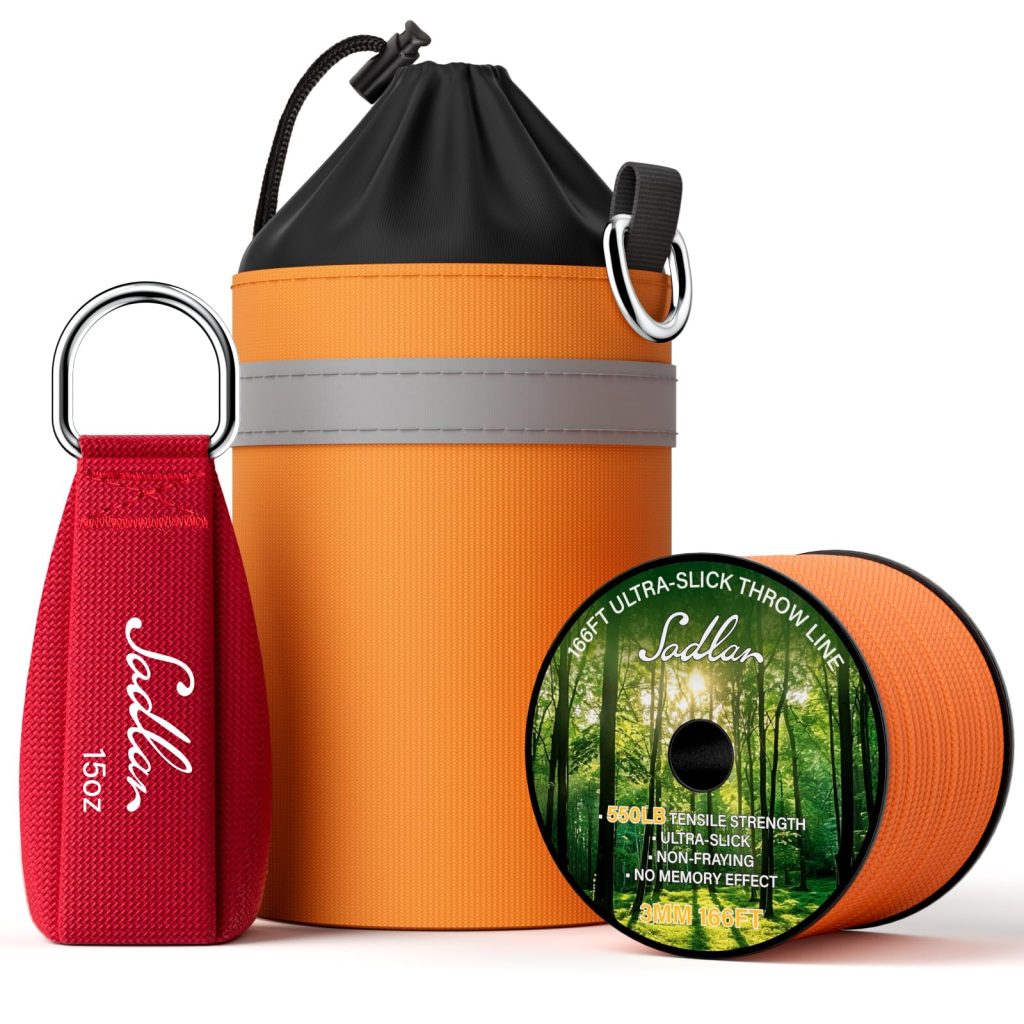
Quick answer: store throw line clean, completely dry, and loosely flaked into a dedicated throw-line cube or container. Feed it into the container in a controlled sequence, keep separate lines divided, secure the throw bag for transport, and inspect the line while packing. Good storage reduces common tangles but cannot guarantee a tangle-free throw.
A repeatable packing routine
- Move to a clean, clear area and disconnect or secure components according to your work practice.
- Remove twigs, chips, grit, and loose debris without dragging the line across pavement.
- Inspect the complete length for cuts, glazing, severe fuzzing, flat spots, contamination, and hard or thin sections.
- Let damp line and the bag dry fully away from direct heat.
- Place the working end where it can be identified, then flake the line into the container with relaxed, alternating placements.
- Close the container so the bag and line cannot spill into other gear during transport.
Choose storage by the problem it solves
| Storage feature | Useful when | Check before use |
|---|---|---|
| Wide opening | You want space to flake line without tight coils. | The line can feed without catching the rim or closure. |
| Separate compartments | You carry two lines or adjacent bag weights. | Ends remain clearly identified and do not cross between sections. |
| Stable open shape | You need a clean feed area at the worksite. | The container stays outside the throw path and exclusion zone. |
| Drainage or ventilation | Gear may be damp after work. | Ventilation does not replace unpacking and complete drying. |
Set up before the first throw
Open the container fully on stable ground, orient the feed toward the target without wrapping the line around tools or feet, and establish an exclusion zone. Pull a short section through the system to confirm free feeding. Never place the container where the falling bag or a redirected line can strike it, a person, a vehicle, or other equipment.
When a tangle appears
Stop and reset instead of throwing harder. Remove twists methodically, inspect the affected section, and reflake the line. A knot, buried loop, crossed compartment, or snagged closure can change the bag’s path. Storage helps organization; line condition, site debris, wind, technique, coatings, and equipment compatibility still affect feeding.
Use boundary
Triberion’s 166-foot polyester line is supplied as a ground-based placement line. Never climb, rig, lift, or support a person with it. Keep throw-line activity away from electrical conductors and use appropriate training, personal protective equipment, and site controls.
Frequently asked questions
Should I wind throw line around my hand or elbow?
A dedicated container with controlled flaking avoids tight body-sized coils and helps create a predictable feed. Follow the line and equipment maker’s instructions.
Can I pack the line while it is wet?
Remove it from enclosed storage and allow all components to dry fully before longer-term storage. Inspect for contamination and damage.
Does a throw cube prevent every tangle?
No. It improves separation and feeding when used correctly, but setup, line condition, debris, wind, and technique still matter.
Sources reviewed
Reviewed September 11, 2026: Petzl ECLIPSE product information, which documents dedicated throw-line storage and separated storage for two lines, plus Triberion catalog records for its kit length and intended use. Petzl does not test or endorse Triberion products.
Evidence boundary
The routine is organizational guidance. It does not promise a tangle-free throw or replace equipment instructions and professional training.
Continue with the complete kit guide and throw-bag weight factors.