
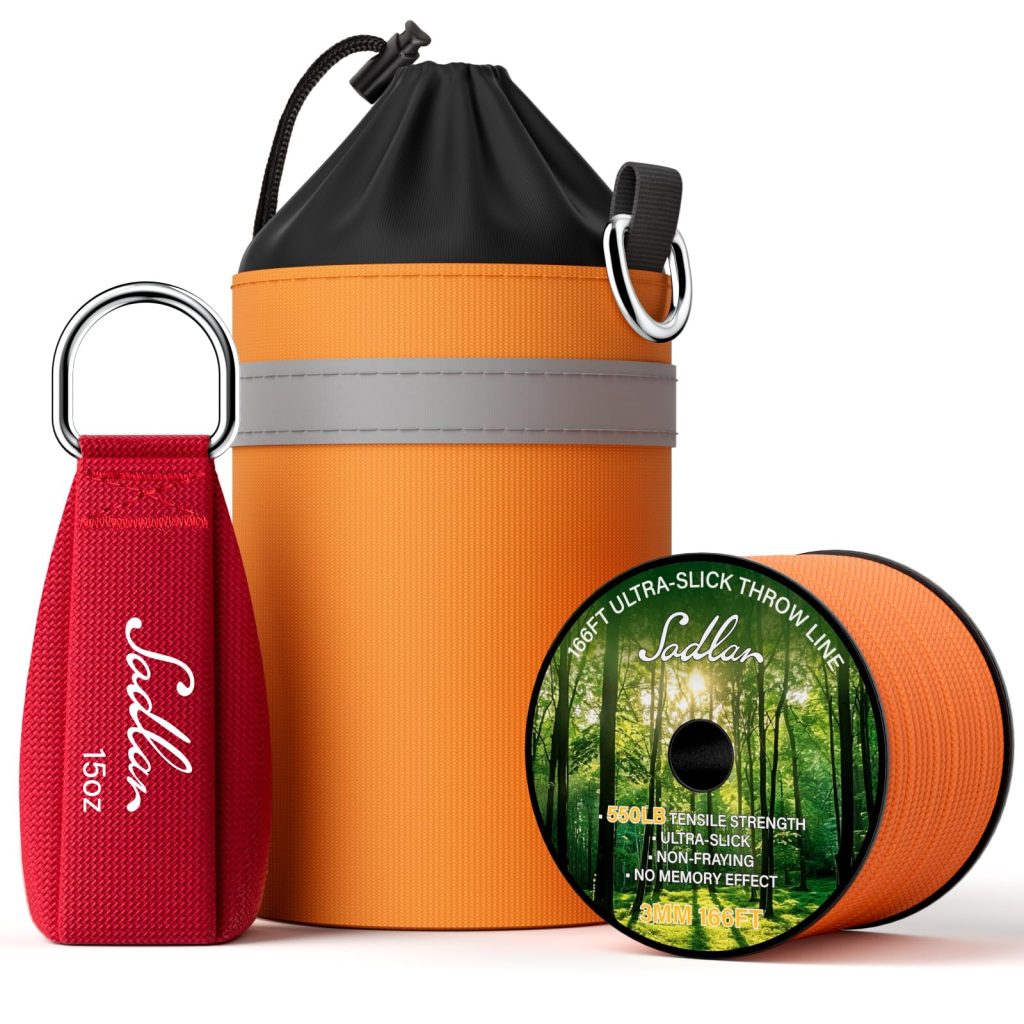
Quick answer: a 12-ounce bag favors easy acceleration and open crowns; 14 ounces is a versatile middle choice; 15 ounces adds return force with a modest weight increase; and 16 ounces is useful when dense foliage or branch friction prevents a lighter bag from returning. Technique, tree condition, and work-zone safety matter more than selecting the heaviest option.
What a throw-line system does
An arborist throw bag carries a lightweight pilot line over a selected branch. Once the bag returns to the ground, the pilot line can pull a separately rated climbing or rigging line into position. The throw line and bag are positioning tools only. They are not designed to support a person, arrest a fall, lower a branch, or serve as rigging equipment.
Bag weight changes acceleration, trajectory, impact energy, and the ability to pull line back through the canopy. Line diameter and surface, bark texture, foliage, branch angle, wind, throw style, and redirects also change the result. That is why a one-size rule cannot replace observation and experience.
Weight comparison
| Weight | Primary advantage | Potential tradeoff | Good starting conditions |
|---|---|---|---|
| 12 oz | Lower throwing effort | Less return force | Open canopy, lower targets, practice |
| 14 oz | Balanced general use | May still hang in dense foliage | Mixed everyday conditions |
| 15 oz | Added return with moderate effort | More fatigue and impact | Medium or higher targets |
| 16 oz | Strongest return in this range | Highest impact and effort | Dense crowns and higher friction |
12 ounces: light and quick
A 12-ounce bag can be easier to accelerate, making it attractive for lower targets, open crowns, repeated practice, or users refining accuracy. Lower mass also reduces fatigue. The tradeoff appears after the bag crosses the branch: foliage, a rough union, or line drag may prevent it from returning. Forcing a stuck light bag with aggressive movement can create a less predictable hazard than switching weights.
14 ounces: the all-around starting point
Fourteen ounces sits near the center of the range and is a practical first choice for mixed conditions. It retains manageable throw effort while adding return force over a 12-ounce bag. Users who work across different tree species may keep 14 ounces as the default and move lighter or heavier only after assessing the target.
15 ounces: a small but useful step
The one-ounce difference from 14 ounces can matter during higher throws or when the line needs a little more pull through the crown. It is still less demanding than the heaviest option. A 15-ounce bag often suits users seeking one balanced kit for medium and high targets without automatically choosing 16 ounces.
16 ounces: maximum return in this group
A 16-ounce bag can be effective in foliage and over branches that create more friction. It also carries more energy and can be tiring during repeated attempts. A larger exclusion zone and disciplined throw control are essential. Do not use extra weight to compensate for a hazardous target, a poor line path, nearby utilities, or a damaged tree.
Safe setup and retrieval
Inspect the entire area before unpacking. Look for electrical conductors, deadwood, weak branch attachments, people, animals, windows, vehicles, roads, and neighboring property. Establish a controlled zone covering the possible flight, rebound, and fall path. Wear appropriate head and eye protection and follow applicable professional practices. If a bag becomes stuck, reassess from a safe position; never stand beneath it or leave it unattended.
Line care
Flake the 166-foot line into a clean throw cube so it feeds without tangles. Avoid stepping on it or pulling it through grit and oil. Dry line and bags before storage. Before every use, check the bag seams, ring or connection point, knot, and the entire line for cuts, glazing, heavy fuzzing, contamination, or flattening. Retire questionable components.
Frequently asked questions
Should a beginner always start with 12 ounces?
No. A lighter bag takes less effort, but a 14-ounce middle option may return more reliably. Training and controlled practice are more important than a universal starting weight.
Can one throw bag handle every tree?
Conditions vary enough that experienced users often carry adjacent weights.
Can the throw line be tied into a harness?
No. It must never be used as a climbing or life-support line.
What if the target is near a power line?
Do not throw. Maintain required professional clearance and select another safe work method.
Compare Triberion throw-line kits
Review and related guidance
Product specifications and safety boundaries in this comparison were rechecked against the current Triberion catalog on September 11, 2026. Continue with our guides to choose a complete throw-line kit or understand placement line and climbing rope.