Fitness Ropes
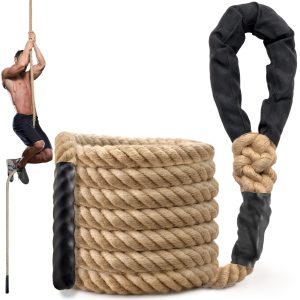
Fitness ropes create demanding, low-tech workouts for grip, pulling power, coordination, and conditioning. Triberion offers two distinct tools: a vertical climbing rope and a ground-based battle rope. They may share a thick 1.5-inch profile, but their setup, movement, space requirements, and safety controls are different.
Climbing rope or battle rope?
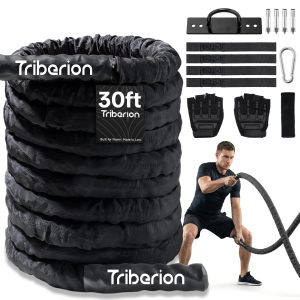
A climbing rope develops grip and upper-body pulling strength as the athlete moves vertically or performs assisted pulls. It requires an engineered overhead anchor, clear fall zone, suitable matting, and supervision. A battle rope remains on the ground and is folded around a stable low anchor. Waves, slams, circles, and pulls raise heart rate and train repeated power without placing the athlete above the floor.
Plan the available space
For a climbing rope, measure from the intended anchor to the floor and choose a length suited to the drills. Excess rope can create a trip hazard, while a rope that is too short limits progression. For a 30-foot battle rope, plan for approximately 15 feet between anchor and athlete plus clear space behind and to both sides. Consider ceiling height, neighbors, noise, floor wear, and access when choosing the station.
Build training gradually
- Begin with short intervals, foot-assisted climbs, or seated pulls while technique develops.
- Keep shoulders controlled and stop before grip or posture breaks down.
- Warm up wrists, elbows, shoulders, and trunk before high-output sets.
- Progress duration, range, or complexity one variable at a time.
Anchors and inspection
Dynamic exercise creates forces that are not obvious from body weight alone. Use a structure and hardware evaluated for the intended movement; do not improvise with decorative fittings or an unassessed tree branch. Before every workout, inspect rope fibers, handles, sleeves, straps, knots, and anchor points. Keep natural rope dry and ventilated, and protect battle rope from sharp concrete edges.
Frequently asked questions
Which option is better for a small home gym?
A 30-foot battle rope needs horizontal clearance, while a short climbing rope needs safe overhead structure and fall protection. Measure the room before deciding.
Is 1.5 inches suitable for beginners?
It is a common all-around diameter. Beginners can scale the drill, duration, body position, or climb height.
Can either rope be used for towing?
No. These products are exercise equipment and are not specified for towing, rescue, or load lifting.
Use our battle rope vs climbing rope comparison to plan the right training station.
Showing all 2 results