
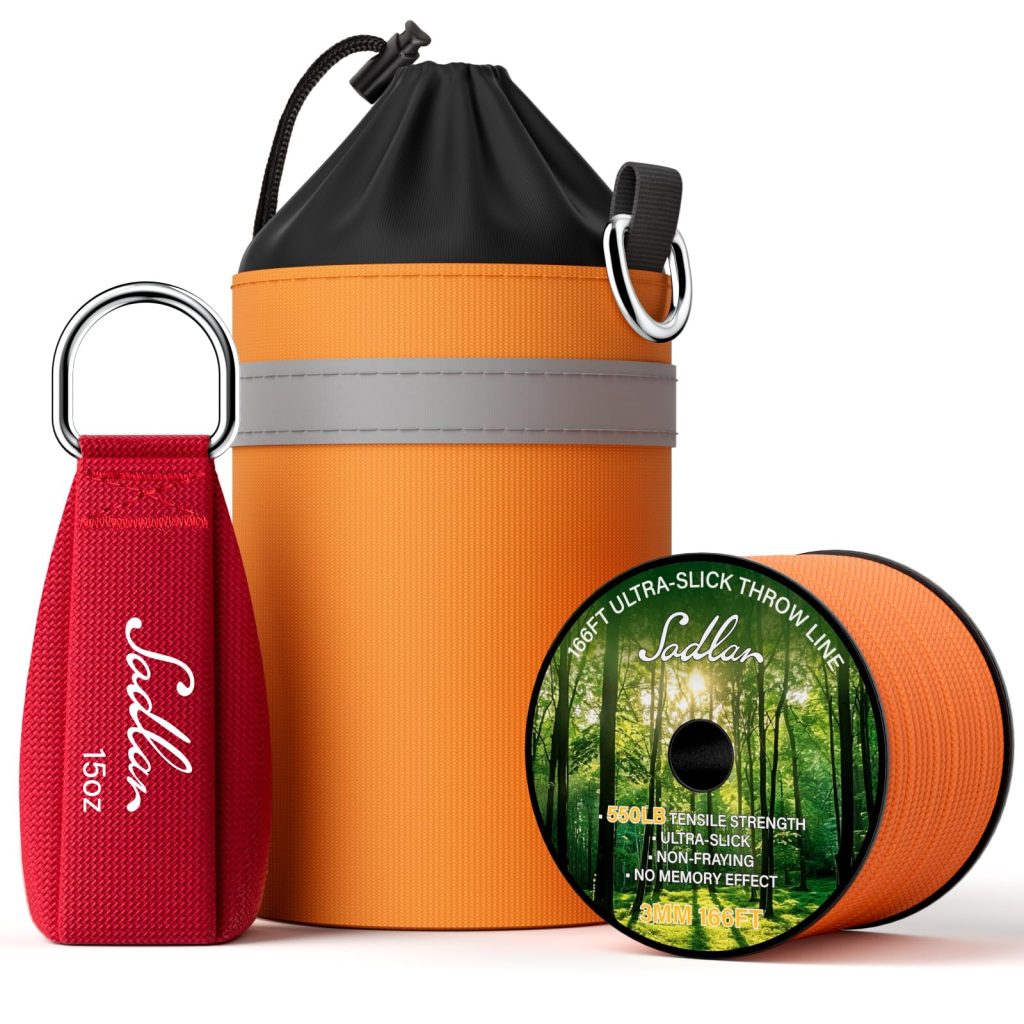
Quick answer: choose a throw-line kit by matching bag weight to your technique and canopy friction. Triberion’s current kits pair a 166-foot polyester placement line with 12, 14, 15, or 16 oz bags. There is no universal best weight in the available product evidence; compare the 12, 14, 15, and 16 oz options against technique, canopy friction, line path, and site conditions. The included line is never a climbing or rigging rope.
Compare the four bag weights
| Weight | Often useful when | Consider |
|---|---|---|
| 12 oz | Open crowns, lower friction, users favoring acceleration | May not return as readily through dense foliage |
| 14 oz | General practice and mixed conditions | A balanced starting point, not a universal answer |
| 15 oz | More return force without choosing the heaviest bag | Slightly more effort per throw |
| 16 oz | Dense foliage or rougher redirects that add friction | More impact energy and fatigue |
Look beyond target height
Branch height matters, but line path and friction often determine whether the bag returns. Bark texture, branch angle, multiple redirects, leaves, wind, line condition, and throwing style all change the result. Experienced users may carry adjacent weights instead of forcing one setup to work in every canopy.
Check line length and the work zone
A 166-foot line provides room for higher placements and retrieval, but it does not make every target appropriate. Inspect the entire flight and fall path. Establish an exclusion zone for people, vehicles, animals, glass, and structures. Look for dead limbs and suspended hazards before throwing.
Electrical and life-safety boundary
Do not conduct throw-line work near electrical conductors. Follow applicable professional clearance rules and choose another method whenever separation is uncertain. Never climb, lift, rig, or support a person with the throw line; use separately certified equipment for the next operation.
What to inspect in a kit
- Bag stitching, covering, attachment loop, and connection knot.
- Line abrasion, glazing, cuts, tangles, and contamination.
- A clean throw cube or container that lets line feed freely.
- A secure storage method that allows wet components to dry.
Practice first in a clear area with appropriate head and eye protection. Technique affects control more than simply choosing the heaviest weight.
Package and storage checklist
- Confirm the selected bag weight and the cataloged 166-foot polyester placement line.
- Check the bag covering, stitching, attachment loop, line connection, and any printed instructions.
- Plan a dedicated container that permits controlled flaking, clean feeding, separation, and complete drying; Petzl’s ECLIPSE information documents this type of purpose-built, divided storage.
- Verify that the work area, technique, and applicable professional procedures support the chosen setup.
There is no universal best first weight in the available product evidence. The 12, 14, 15, and 16 oz options should be evaluated against technique, canopy friction, line path, impact risk, and local practice. Continue with storage and tangle-reduction guidance and polyester vs HMPE selection factors.
Frequently asked questions
What is the best first throw-bag weight?
The available product records do not establish a universal first weight. Choose from 12, 14, 15, or 16 oz using technique, canopy friction, line path, impact risk, and applicable professional guidance.
Is the kit ready for climbing?
No. It positions a pilot line. A separately rated climbing system, inspection, training, and appropriate procedures are required.
Should I buy more than one weight?
Adjacent weights can help when you regularly work across open and dense canopies, but first learn controlled technique in a safe practice area.
Product evidence used
Kit length, material, and available bag weights were checked against Triberion’s four catalog records and their corresponding Amazon listing URLs on September 11, 2026. The comparison describes selection factors and does not assign a certified working method or electrical clearance.