
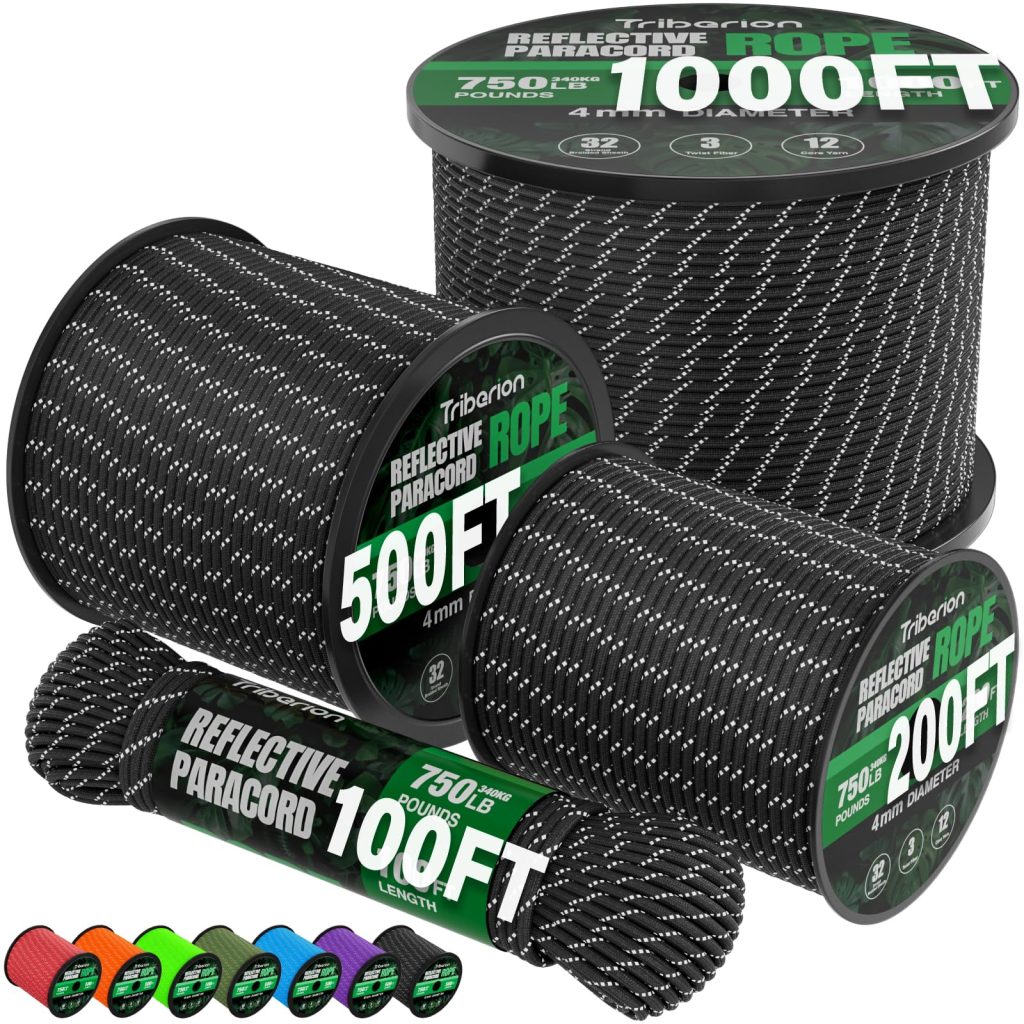
Quick answer: for ordinary camping organization and repairs, start with 4 mm utility paracord in a length that covers the planned runs plus knot allowance and reserve. Choose reflective cord for guylines or markers you need to find with a headlamp. Choose standard cord when visibility is less important. Never use utility paracord for climbing, fall protection, rescue, towing, or overhead lifting.
Match the cord to the camp task
Camping creates many small cordage jobs, but they do not all carry the same consequence. Gear loops, zipper pulls, bundled firewood, clotheslines, tarp organization, and temporary repairs usually benefit from compact cord that knots easily. Tent and tarp guylines also benefit from visibility and low stretch appropriate to the shelter design. Any task that supports a person or controls a dangerous load requires purpose-built, certified equipment instead.
Standard or reflective paracord?
| Choose | When it fits | Tradeoff |
|---|---|---|
| Standard paracord | Repairs, crafts, pack organization, utility lines | Harder to notice after dark |
| Reflective paracord | Guylines, tent markers, gear you locate by headlamp | Reflection needs an external light source |
Reflective cord does not glow by itself. Test it from the angles and distances used at camp, and add bright flags where a trip hazard remains.
Choose strength without treating it as a working load
Triberion lists 550, 750, and 1000 lb paracord options. Those figures are product strength specifications, not certified safe working loads. Knots, wet grit, abrasion, sharp edges, heat, sunlight, shock loads, and age all reduce real performance. For camp utility, select construction based on handling, bulk, and the job; do not calculate a life-safety use from the label.
Estimate the length
- Measure each planned run, including both sides of a tarp or shelter.
- Add the cord consumed by knots and tensioning hardware.
- Add a separate repair reserve that remains dry and clean.
- Prefer several identified lengths when one long spool would be inconvenient in the field.
A 50-foot reflective cord suits a focused set of markers or guylines. A 100- or 200-foot spool supports a broader camp kit. Larger spools make sense for groups, property camps, or repeated projects, but only if the extra bulk will actually be carried and kept organized.
Inspect before every trip
Run the sheath through your hands and look for cuts, glazing, flattened areas, exposed core strands, chemical contamination, severe fading, or stiff sections. Check the parts that rub against stakes, bark, rocks, and hardware. Retire damaged sections rather than hiding them inside a knot. Dry dirty or wet cord before storage and keep it away from fuel, solvents, flame, and prolonged sunlight.
Camp task and hardware check
- Tent or tarp line: follow the shelter manual, verify that the approximately 4 mm cord enters and locks in every tensioner, and test for slipping before travel.
- Night marker: reflective detail needs a headlamp or flashlight and does not eliminate a trip hazard.
- Repair or organization: carry measured, labeled lengths plus knot and trimming allowance.
- Person-supporting task: use equipment designed and rated for that purpose.
REI’s tent setup guidance, reviewed September 11, 2026, recommends guylines for added stability in wind and carrying extra line, stakes, and tensioners. It does not establish compatibility with a particular replacement cord. See the focused guide: Can You Use Paracord for Tent Guylines?
Frequently asked questions
Is 550 cord enough for camping?
It is a common choice for non-critical camp utility. The exact answer depends on the task and condition of the cord, and the label is not a safe working-load rating.
Should every tent use paracord guylines?
Follow the shelter maker’s instructions. Some shelters and tensioners work best with a particular diameter or low-stretch line.
Can paracord hang a hammock?
Do not use general utility paracord as hammock suspension. Use a suspension system designed and rated for supporting people.
Product evidence used
This guide was reviewed against Triberion’s catalog records for 4 mm 550 lb, 750 lb, reflective 750 lb, and 1000 lb paracord on September 11, 2026. The records identify the corresponding Amazon listing for each product; selection and safety guidance intentionally stays within non-life-safety utility use.