
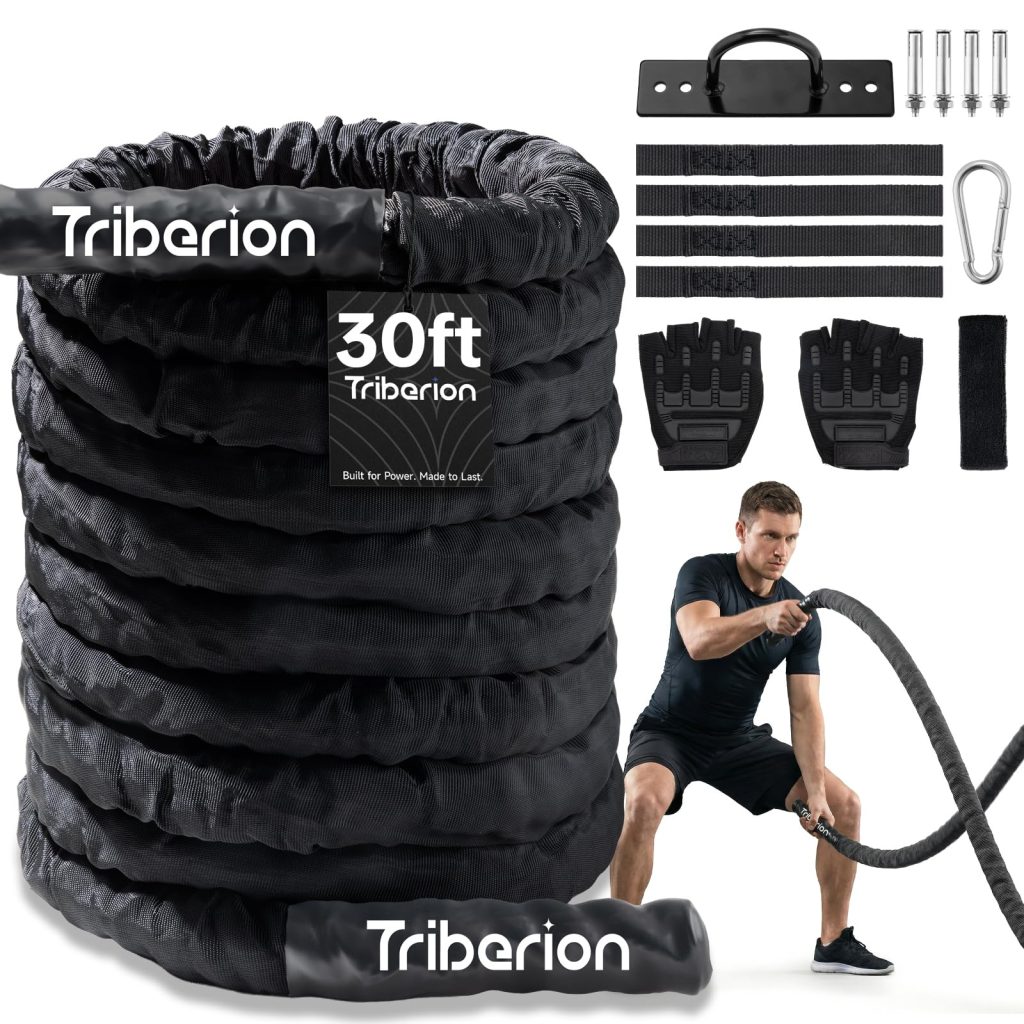
Quick answer: choose a battle rope for ground-based conditioning, repeatable intervals, and waves or slams. Choose a climbing rope for vertical pulling, grip endurance, coordination, and climbing-specific progressions. A battle rope needs horizontal floor space and a stable low anchor; a climbing rope needs an engineered overhead anchor, a clear fall zone, appropriate matting, and closer supervision.
Two ropes, two different training problems
A battle rope is folded around an anchor so the athlete controls both free ends. Movement travels down the rope as waves, circles, slams, or pulls. The user stays on the ground, making intensity easy to adjust through pace, amplitude, stance, and distance from the anchor.
A climbing rope supports upward and downward movement. The hands, feet, back, arms, trunk, and coordination work together to manage body weight. Even partial climbs introduce height, so installation and supervision carry greater consequences than a ground-based conditioning tool.
Comparison at a glance
| Factor | Battle rope | Climbing rope |
|---|---|---|
| Main training | Conditioning and repeated power | Grip and vertical pulling strength |
| Anchor | Stable low anchor | Engineered overhead anchor |
| Space | Horizontal lane | Vertical clearance and fall zone |
| Beginner scaling | Shorter intervals, smaller waves | Assisted pulls, foot locks, partial height |
| Primary risk | Strain, trip area, anchor movement | Falls and anchor failure |
What a battle rope trains
Alternating waves build repeatable output and shoulder endurance. Double waves and slams involve more trunk and lower-body force. Circles and lateral patterns challenge coordination, while pulls can emphasize the back and grip. Because the athlete remains grounded, workouts can move quickly between high effort and recovery.
A 30-foot rope normally creates about 15 feet from the folded anchor to the handles. Add clearance behind and beside the athlete. A 1.5-inch diameter is a common all-around size: it challenges grip without the mass of a thicker commercial rope. Beginners can stand closer to the anchor, use smaller waves, and work in brief intervals.
What a climbing rope trains
Rope climbs develop powerful pulling, grip endurance, body tension, and foot technique. Training does not need to begin with a full ascent. Seated hand-over-hand pulls, standing rope rows, controlled hangs where appropriate, and low foot-lock practice can build prerequisites. Progress only when the athlete can ascend and descend under control.
Length should follow measured anchor height and the planned endpoint. Too little rope limits use; excessive rope on the floor creates clutter and trip risk. Natural rope needs dry storage and frequent inspection, particularly near the anchor and any area repeatedly gripped or contacted by footwear.
Anchor requirements decide many installations
Dynamic exercise can create forces beyond the athlete’s static body weight. A decorative ceiling hook, railing, light pole, or visually large tree branch is not automatically safe. A qualified person should evaluate the structure, compatible hardware, direction of loading, inspection access, and surrounding area. Battle-rope anchors must resist repeated horizontal pulls; climbing anchors must address personal fall consequences.
Programming and progression
For battle ropes, start with controlled 10- to 20-second sets and generous rest. Improve posture and wave consistency before extending duration. For climbing ropes, develop pulling strength and secure foot technique at low height before attempting a full climb. In both cases, warm up the shoulders, elbows, wrists, hands, and trunk, and stop before fatigue makes the movement uncontrolled.
Care and inspection
Uncoil ropes fully before use. Protect battle rope from sharp concrete edges and keep the sleeve at the anchor contact point. Let damp equipment dry before storage. Check handles, fibers, straps, stitching, knots, and anchors before every workout. Natural climbing rope showing rot, loosened strands, deep cuts, or substantial wear should be removed from use.
Frequently asked questions
Which is better for cardio?
Battle-rope intervals are generally easier to structure for continuous conditioning because the athlete stays on the ground.
Which needs more room?
It depends on the room: a battle rope needs a long floor lane, while a climbing rope needs safe vertical clearance and a fall zone.
Can the same rope do both jobs?
Do not assume so. Construction, end treatment, wear pattern, and anchor arrangement are different. Use each product for its intended exercise.
Can either rope tow a vehicle?
No. Fitness ropes are not towing, rescue, or load-lifting equipment.