
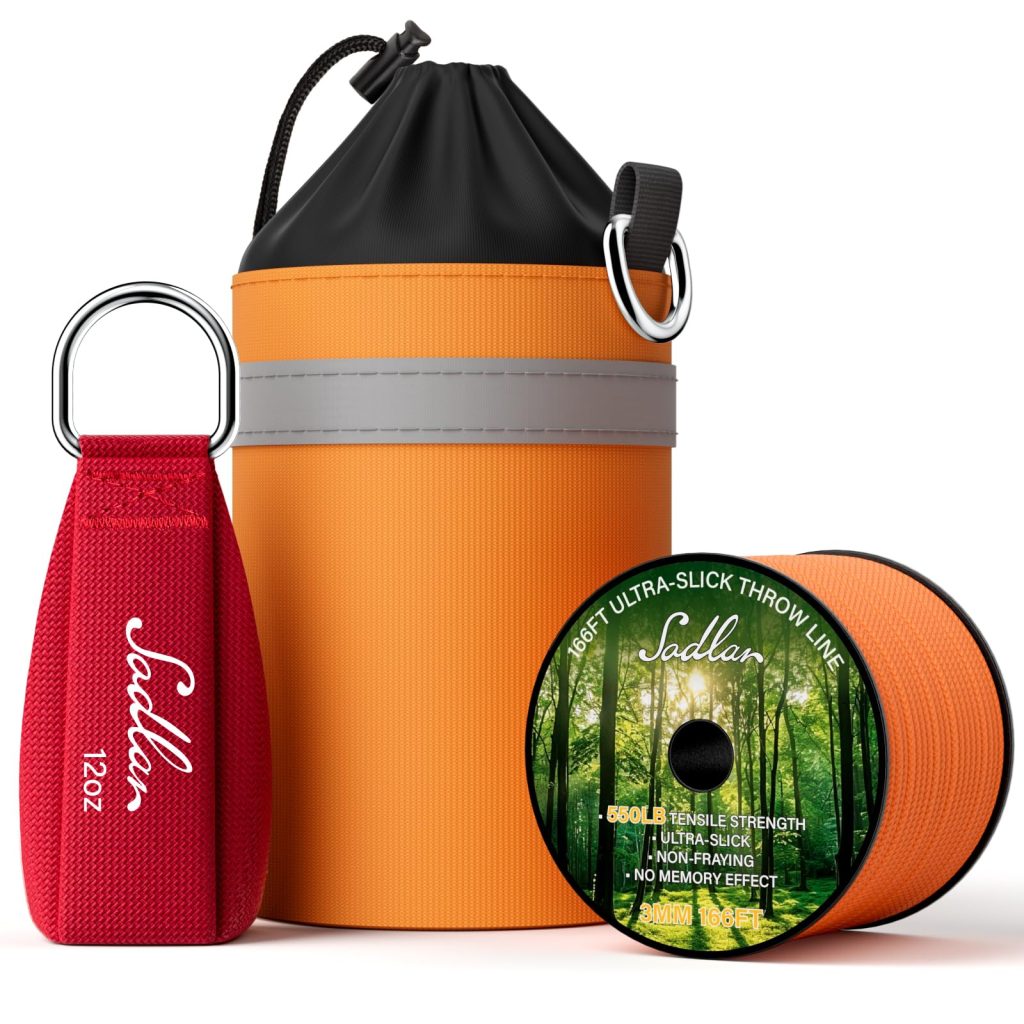
Quick answer: choose a throw line by the verified finished product, not fiber name alone. Material, diameter, braid, coating, surface finish, elongation, visibility, line length, bag connection, and handling all affect a placement system. Triberion’s current kits specify a 166-foot polyester placement line; this guide does not claim it performs like an HMPE line or rank it against a product that Triberion has not tested.
Compare the finished-line facts
| Factor | Question to ask | Why it matters |
|---|---|---|
| Material and braid | Are both fiber and construction documented? | Two lines with the same fiber can handle differently. |
| Diameter and mass | Are they compatible with the bag, connection, and technique? | Size changes grip, drag, packing, and connection fit. |
| Coating and surface | Is the finish documented for the exact line? | Finish can affect feeding, abrasion behavior, and feel. |
| Visibility | Can the line be traced against the expected canopy? | Color and contrast help inspection and retrieval. |
| Length | Does it cover placement and retrieval without poor line management? | Extra length still needs clean storage and control. |
What an HMPE example can tell you
Teufelberger describes its dynaGLIDE as a coated, 12-braid HMPE throw line and identifies visibility, low elongation, abrasion resistance, and smooth movement over bark as product features. Those are useful comparison categories. They are claims for that finished product, not universal values for all HMPE lines and not evidence about Triberion’s polyester line.
What the Triberion record confirms
Triberion’s four current kits pair a 166-foot polyester placement line with a 12, 14, 15, or 16 oz throw bag. The catalog establishes those facts and a ground-based placement purpose. It does not provide a controlled polyester-versus-HMPE test, coating specification, elongation percentage, abrasion result, or universal bag-weight recommendation. Buyers who need one of those values should request documentation before relying on it.
Run a low-risk compatibility check
- Confirm the exact line, bag, attachment method, and storage container.
- Inspect the line and connection before each session.
- Practice in a clear area away from people, property, dead limbs, and electrical conductors.
- Observe feeding, visibility, snagging, retrieval, and line condition without treating a practice throw as a strength test.
- Change one component at a time so differences are easier to identify.
Placement line only
Neither polyester nor HMPE fiber makes a throw line suitable for climbing or rigging. A placement line must never support a climber, arrest a fall, lift a load, or substitute for a separately rated climbing or rigging system.
Frequently asked questions
Is HMPE always better than polyester for throw line?
No universal ranking is supported here. Compare exact products, documentation, technique, compatibility, and the working environment.
Does lower stretch make a line safe for climbing?
No. Throw line remains a placement tool regardless of stretch. Use certified, system-compatible life-support equipment.
Which throw bag works with each material?
Fiber alone does not determine bag choice. Line diameter, surface, canopy friction, connection, technique, and manufacturer guidance all contribute.
Sources reviewed
Reviewed September 11, 2026: Teufelberger dynaGLIDE product information for one documented HMPE-line example, and Triberion catalog records for its polyester kit configuration. Teufelberger does not test or endorse Triberion products.
Evidence boundary
No cross-brand performance result, certification equivalence, or “best” material claim is made without a controlled test of the exact products.
Read throw line vs climbing rope and throw-line storage guidance.