
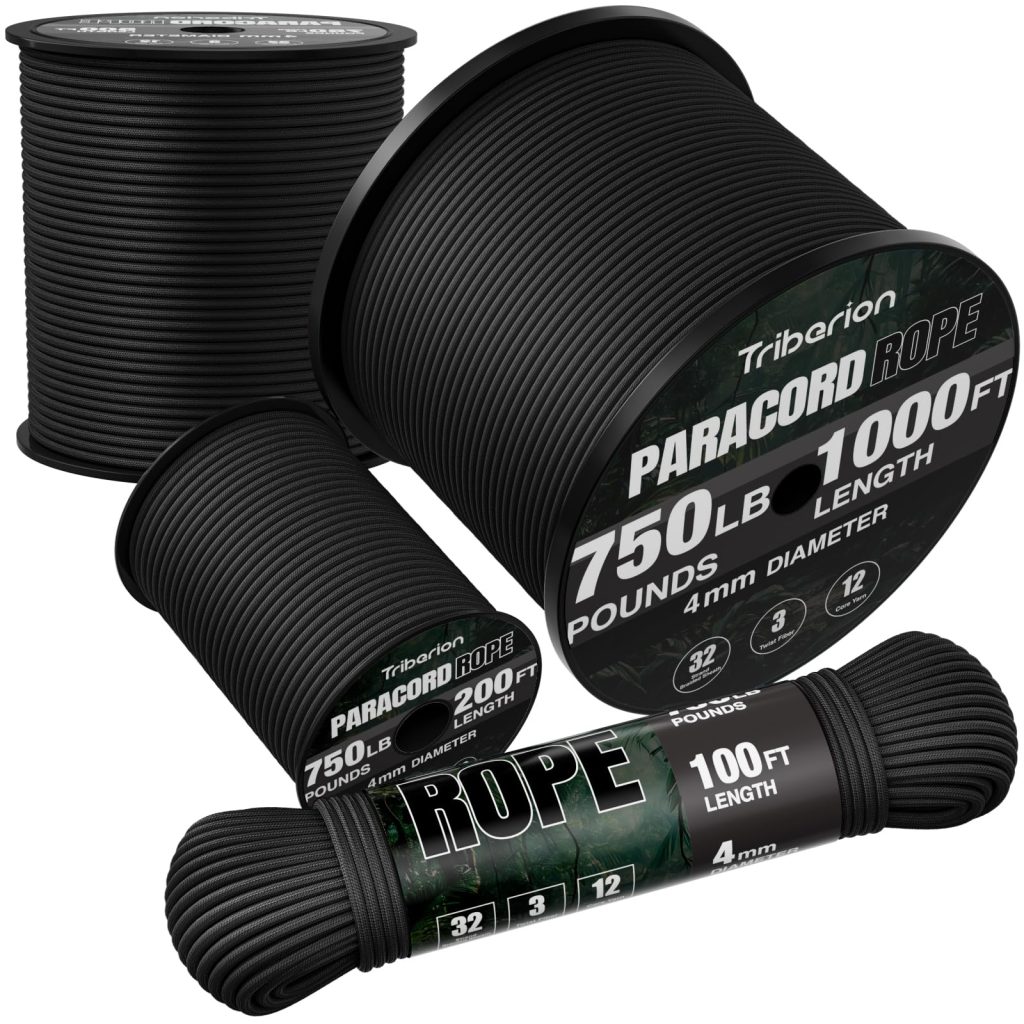
Quick answer: choose 550 lb paracord for compact everyday crafts and kit use, 750 lb cord when you want more stated capacity with familiar 4 mm handling, and 1000 lb cord for more demanding non-life-safety utility projects or high-volume use. The number is not a safe working load, and none of these products replaces certified climbing, towing, rescue, or lifting rope.
Why the numbers are only a starting point
Paracord labels make comparison look simple, but real project performance depends on more than the largest pound figure. Construction, material, diameter, knot choice, abrasion, anchors, age, heat, moisture, chemicals, and shock all affect the finished system. A knot can reduce the strength of a cord, while a sharp edge can damage even a higher-rated product quickly. Use the rating to compare products in the same utility category, then apply a conservative margin and inspect the complete setup.
At-a-glance comparison
| Option | Listed construction | Best fit | Typical Triberion lengths |
|---|---|---|---|
| 550 lb | 4 mm, 7 strand | Crafts, small kits, light utility | 100 ft |
| 750 lb | 4 mm, 12 strand | Camping, preparedness, frequent utility | 50–1,000 ft depending on version |
| 1000 lb | 4 mm, 13 strand nylon | Higher-capacity utility and bulk projects | 200 or 500 ft in this collection |
When 550 lb paracord makes sense
Standard 550 cord is familiar, compact, and easy to incorporate into established bracelet, lanyard, handle-wrap, and zipper-pull patterns. A 100-foot length fits neatly in a vehicle kit, pack, or workshop drawer and is enough for several small projects. It is often the sensible choice when the cord is being used to organize gear, replace a lace, bundle equipment, add a pull tab, or build a decorative item.
Choosing 550 cord can also avoid paying for capacity a project does not use. For temporary outdoor lines, remember that wind and movement introduce repeated loading. Protect the cord from sharp edges and inspect it rather than assuming an unused portion of the rating is a permanent safety margin.
Why move to 750 lb paracord?
Triberion 750 lb paracord increases the listed construction to 12 strands while retaining an approximate 4 mm diameter. That makes it attractive when the user wants compact knots and accessory compatibility but prefers additional stated capacity. It is a versatile middle option for tarp organization, camp repairs, long utility runs, clotheslines used conservatively, preparedness supplies, and frequent DIY projects.
The reflective 750 lb version serves a separate purpose: it returns directed light so a headlamp or flashlight can make the cord easier to find. Reflection does not mean the cord produces light on its own, and it does not change the need to mark trip hazards clearly.
When 1000 lb cord is worthwhile
The 1000 lb option uses a listed 13-strand nylon construction. It suits users who need a higher stated rating for non-life-safety applications but still prefer a compact cord over conventional thick rope. Larger spools also make sense for clubs, workshops, frequent campers, or makers preparing many kits. A continuous 500-foot spool reduces joins and allows efficient cutting.
Higher stated strength does not turn paracord into rigging equipment. If a failure could injure someone, damage valuable property, expose a person to a fall, or drop a load, select purpose-built equipment with documented working-load limits and compatible hardware.
How much length should you buy?
Sketch the project and measure each finished run. Add the cord consumed by knots, bends, splices or wraps, then allow for trimming, test pieces, errors, and later repairs. Small craft patterns can consume far more material than their finished length suggests. A 100-foot package is convenient for occasional work; 200 feet allows several medium jobs; 500- and 1,000-foot spools suit repeat use and long continuous runs.
Care and inspection
Store paracord dry, loosely organized, and away from prolonged sunlight or chemicals. Cut with a sharp tool. If heat-sealing a synthetic end, work in ventilation, control the flame, and avoid touching molten material. Before reuse, check the sheath for cuts, glazing, flattened spots, heavy fuzzing, contamination, or exposed core strands. Retire questionable sections rather than hiding damage inside a knot.
Verified construction and length comparison
| Current option | Verified diameter | Verified construction | Verified catalog lengths |
|---|---|---|---|
| 550 lb | 4 mm / 5/32 in | 7-strand paracord | 100 ft |
| 750 lb | 4 mm / 5/32 in | 12-strand paracord | 100, 200, 500, or 1,000 ft |
| Reflective 750 lb | 4 mm / 5/32 in | 12-strand reflective paracord | 50 ft |
| 1000 lb | 4 mm / 5/32 in | 13-strand nylon cord | 200 or 500 ft |
These are catalog facts reviewed September 11, 2026, not results from an independent comparison test. The pound figure is a stated strength and cannot be divided by a generic safety factor to create a safe working load. Knots, bends, abrasion, shock, heat, chemicals, age, and test method all affect the finished assembly. See Samson’s rope selection information for general explanations of strength, working load, construction, and fiber properties; its figures are not Triberion test results.
For material-sensitive work, also read what to verify about nylon and polyester cord.
Frequently asked questions
Is 1000 lb paracord twice as safe as 550 cord?
No. The listed figures are not working-load limits, and a complete tied system behaves differently from a new straight sample.
Do more strands always mean a larger diameter?
Not in this range. The listed Triberion options retain an approximate 4 mm profile while changing internal construction.
Which cord is best for a first bracelet?
Four-millimeter 550 cord is a familiar starting point with many available patterns, but 750 lb cord can also work when its finished feel suits the design.
Can any of these cords support a hammock or climber?
Do not use utility paracord as life-support equipment. Select a rated hammock suspension or certified climbing system designed for the application.
Review and related guidance
Product specifications and safety boundaries in this comparison were rechecked against the current Triberion catalog on September 11, 2026. Continue with our guides to choose paracord for camping or inspect and replace worn paracord.