
Quick answer: make a short sample in the exact cord, weave, and tightness you plan to use, measure how much cord the sample consumes, then scale that result and add 10–20% for knots, trimming, and mistakes. A test piece is more reliable than a universal feet-per-inch rule because patterns and hand tension vary.
Use a sample-based estimate
- Build a repeatable sample, such as one inch of a bracelet weave or one complete handle-wrap repeat.
- Mark the cord at the start and finish without stretching it.
- Undo the sample and measure the consumed length.
- Multiply by the number of inches or repeats in the finished item.
- Add cord for attachment knots, melted or whipped ends, trimming, and a reserve.
For two-color work, measure each color separately. Some patterns consume the core color and outer color at different rates. For mirrored projects, complete one side before cutting the second set of strands.
What changes cord consumption?
Dense weaves, larger objects, tighter hand tension, additional colors, internal cores, and decorative knots all use more cord. A 4 mm cord also behaves differently from thinner micro cord. Handle wraps consume more material when the handle has a large circumference, so measure around the handle rather than relying on its length alone.
Choosing a spool length
| Project pattern | Practical approach |
|---|---|
| One small project | Calculate from a sample and buy enough for one retry |
| Several matching items | Finish one item, record actual use, then scale the batch |
| Long wrap or repeated production | Use a continuous spool to reduce joins and batch variation |
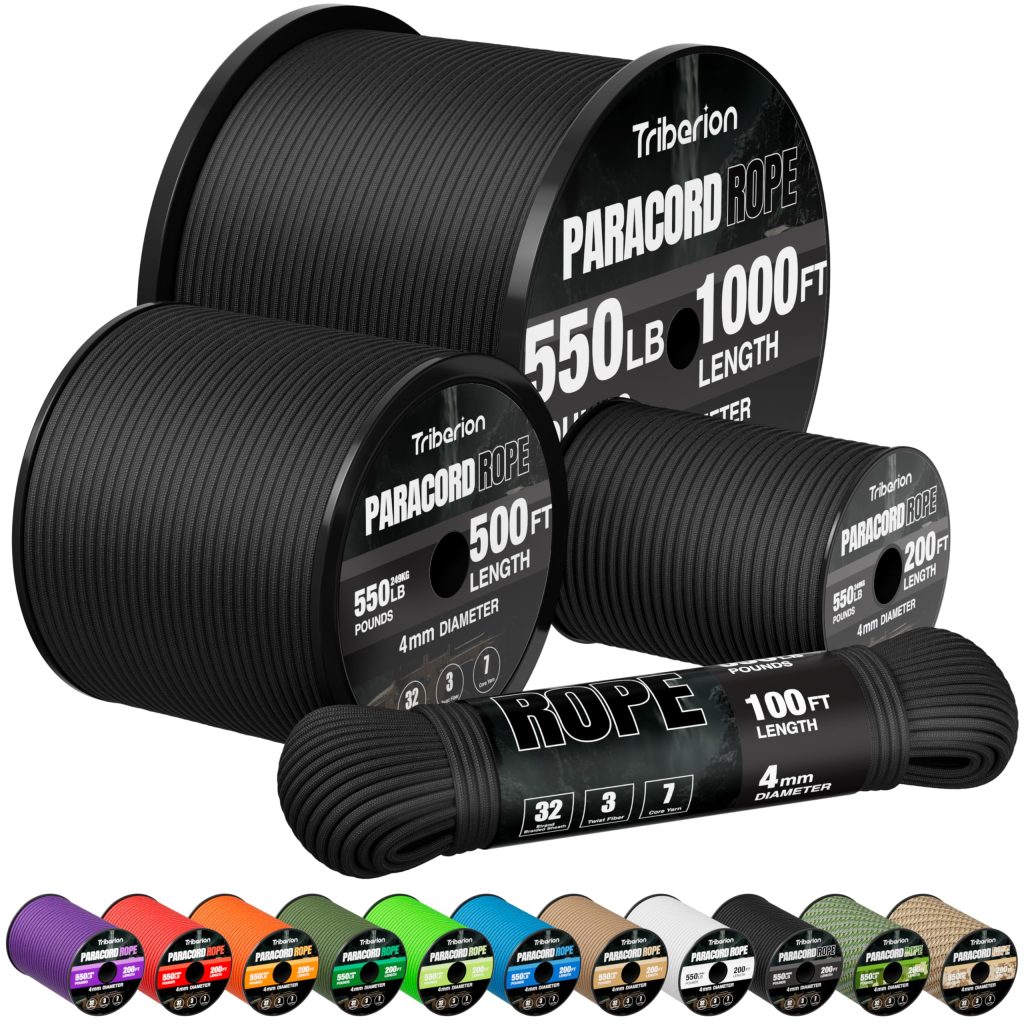
Triberion offers 100-foot and larger standard-cord options, plus a 50-foot reflective option for smaller visibility-focused projects. Check the current color and length configuration on Amazon before ordering.
Plan cuts before making them
Write a cut list and label each piece. Keep the uncut reserve on the spool until the fit is confirmed. If the project passes through holes, buckles, or beads, verify that the approximate 4 mm diameter fits before cutting the full set. Natural variation in knots and tension makes a small reserve useful even after careful calculation.
Worked sample calculation
Illustrative example, not a Triberion product test: suppose a two-inch sample consumes 11 feet of color A and 7 feet of color B. An eight-inch finished woven section needs four sample repeats, so the starting estimates are 44 feet of A and 28 feet of B. Adding a 15% planning reserve gives 50.6 feet of A and 32.2 feet of B; round upward to practical cut lengths. Measure each color separately because a two-color pattern may not consume them evenly.
Repeat the sample with the exact 4 mm cord, buckle, weave, and hand tension. A calculator or this example supplies only a starting method; the user’s measured sample is the evidence for the final cut list.
Frequently asked questions
Can I use an online bracelet calculator?
Use it as a starting estimate, then verify with your own sample. Cord diameter, wrist allowance, buckle length, pattern, and tension can change the result.
How much extra should I buy?
Ten to twenty percent is a practical planning reserve for many crafts, but first attempts and complex knots may need more.
Can leftover craft cord be used for climbing?
No. Utility paracord and offcuts are not climbing, fall-protection, rescue, towing, or lifting equipment.
Product evidence used
This guide uses Triberion’s cataloged 4 mm diameter and current spool-length choices, reviewed September 11, 2026. The sample method is supplied because the catalog does not claim a universal consumption rate for craft patterns.